-
This site is for wood & materials, some are hard to get, that you need for a vintage correct Les Paul replica-project or for tuning your existing guitar.
CHECK THE LES PAUL PARTS IN OUR NEW WEBSHOP, CLICK HERE:
-
The vintage Les Paul Standard has a Honduran mahogany neck with a BRW fretboard, crown inlays of (thin/2 mm) pearloid. The body is of Honduran mahogany (core) and topped with a (flamed) maple cap of approx. 1/2 inch. Typically it has 2 humbuckers and a (lightweight) stoptail made from aluminium, screwed directly into the wood (no bushings, see pic below); modern LPs tailpieces are equipped with bushings. The bridge is fixed to the body with bushings (see pic below: right holes). The origninal ABR-1 bridge is made from nickel with brass saddles (in the 60´s these saddles were changed from brass to nylon 6/6). The vintage 1959 Les Pauls have the ABR-1 bridge with brass saddles. Additionally you can see in the right upper corner of the pic below a volume pot with split shaft and pointer installed (note the angle of the pot on the wood). There is more to know, this is just the short version.
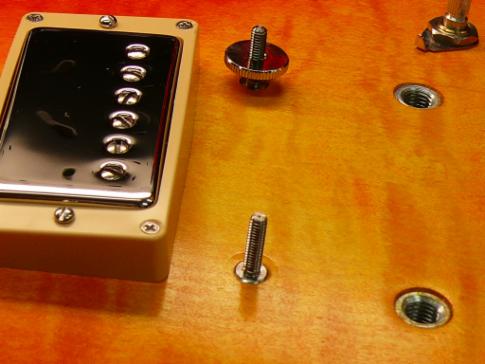
Step by step we offer here the needed materials incl. new hardware according vintage specs. Check back regulary - or ask for being put on the "LP-project-email-list" with news about the subject and pics from vintage Les Pauls prior 1960.
-----------------------------------------------------------------------------------------------------
Announcement: we have started the CNC-production of vintage correct parts for our project.
If you are interested in our LP-newsletter just drop us a line; within this you can find the vintage correct measurements and dimensions we used (and you can correct the StewMac-plan ...).
1. CNC´ed mahogany bodies
First of all we are now CNC´ing mahogany body blanks according vintage correct specifications. We were lucky enough to get a master body from the most profiled luthier (and fountain of knowledge) of replicas, well known from his various posts on www.mylespaul.com ...
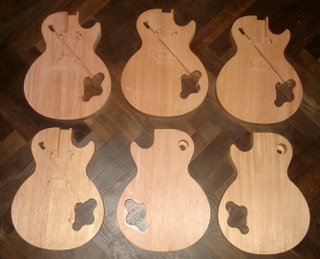
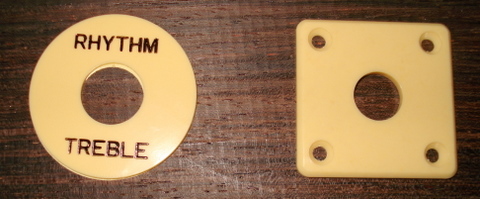
All bodies can be ordered with rout for recessed plastic covers for the toggle-switch and e-cavity (left body on pic below) or without (right body on pic below). Please note that the rout will be according the dimensions of the usual replacemnt parts, but these are not vintage correct (but easily available).
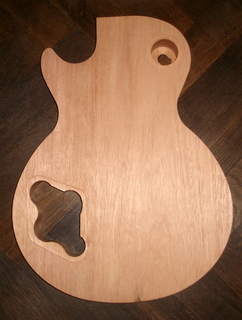
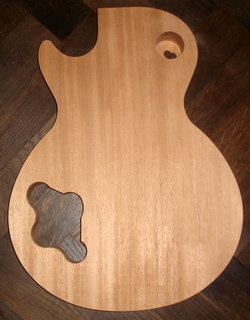
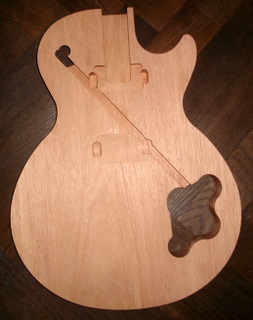
note that the wiring-chanel/toggle-switch area: the hole for the toggle-switch is wider than the hole you can see on top as there is thin mahogany left - just like it was in the old days.
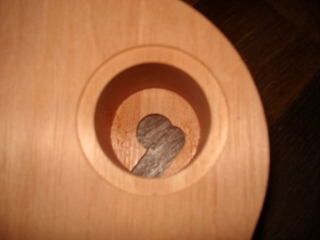
If you want to make a vintage correct guitar you would have to order the non-rout version and rout yourself for the vintage correct dimensions of the recessed plastic covers. Please note that these are - as far as we know - not available, so you will have to make your own.
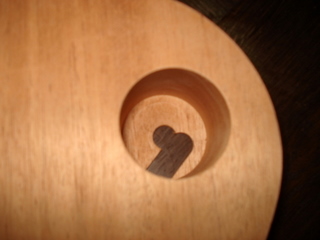
This "puzzle system" allows the use of modern plastic covers and gives you the freedom to rout for other specifications (when ordering the "non-rout" version).
---
Below: non-rout version, same principle applies for the e-cavity.
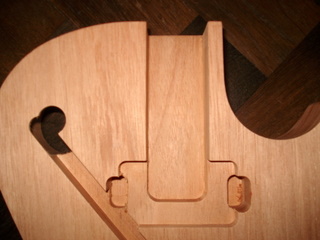
Below: front view of body with 3.9 degree neck angle (long tenon) and 3 degree tilt bottom of humbucker cavities.
Below: vintage correct shape and dimension of e-cavity
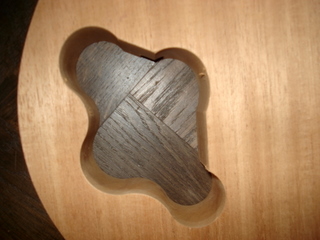
Below: wiring chanel and wide "foot" for the right (treble) humbucker
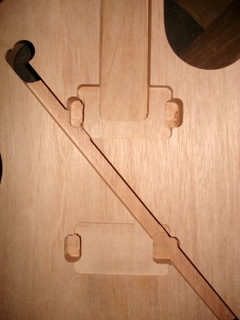
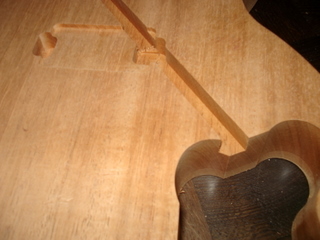
All bodies come 1/100th ovesized for final sanding.
CNC´ed body is 295 Euro/body (incl. wood/Honduran mahogany).
---
2. CNC´ed vintage correct fretboards
We offer a CNC-service for vintage correct fretboards incl.
- "old rule of 18" vintage scale
- 12`` radius
- 0,50 mm fret slots (12``radiused)
- correct sized cavities for crown inlays (with 12`` bottom rout), 1,2 mm depth (Dave Johnson´s inlays fit perfectly)
- vintage correct wedge shaped
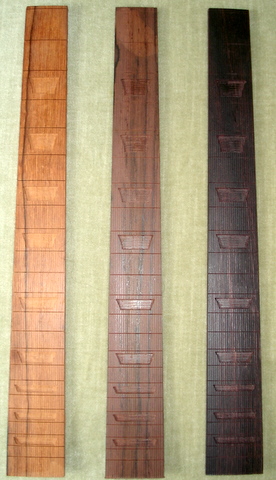
A fully CNC´d fretboard (trimmed to +1mm width on both sides) with inlay cavities and fret slots and 12`` radius is 175 Euro incl. EIR fretboard and all vintage details, designated for the small vintage frettangs. The board is vintage-correct wedge shaped, being slightly thicker at the body end than on the nut.
Vintage fretwire with small tang and "LesPaul-crown" vailable in limited quantities - ask.
You can send in your fretboard for CNC´ing or choose from our wide range of species.
3. real CELLULOID binding
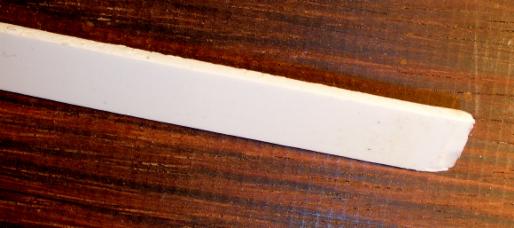
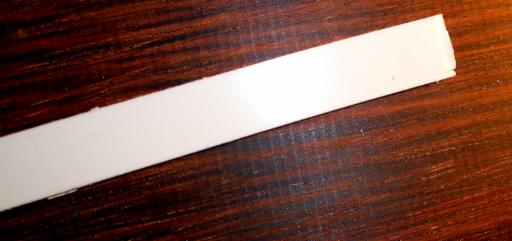
History: vintage Les Pauls had (off) white celluloid binding around the fretboard and "a bit creamish" ABS binding around the body. Thickness of the celluloid fingerboard binding was (due to sanding a little below) 1.0 mm and the ABS body binding measures (due to sanding a bit below) 2.0 mm.
Because of the different materials (and colors) you can clearly see the two different colors on vintage Gibson necks and bodies from that period.
A good demonstration of this you can see in a post on MLP, where a member is doing a repair job for a 1959 ES 355. Here you can see the still different colors of the body and fretboard binding (once it is scraped off the aged/tinted lacquer).
We were recently lucky to find and obtain one of maybe Europe´s
last real Celluloid boards that matches the color and that are thick enough for fretboard binding. This is cut into oversized binding strips (1.6 mm thick, 7.0+ mm wide, 1600+ mm length), length would even be good for a guitarbody. "One size fits all"-approach, when using this for binding of a fretboard you will need to sand down the thickness to vintage correct specs.
The color matches the vintage color, what is an off-white ("ivoryish"), pic above shows this color (on BRW fretboardblank).
The best stuff for a vintage correct replica build or for restoration/repairing vintage guitars from that period.
17,50 Euros/strip
-----
A: Raw Woods
1. Maple topsNEW IN: Eastern HARD MAPLE TOPS !
We are very glad to have found a reliable source for excellent Eastern HARD MAPLE TOPS from his excellent stock of old woods, being a long-time supplier of Gibson´s custom shop.
For pics of actual available sets click here.
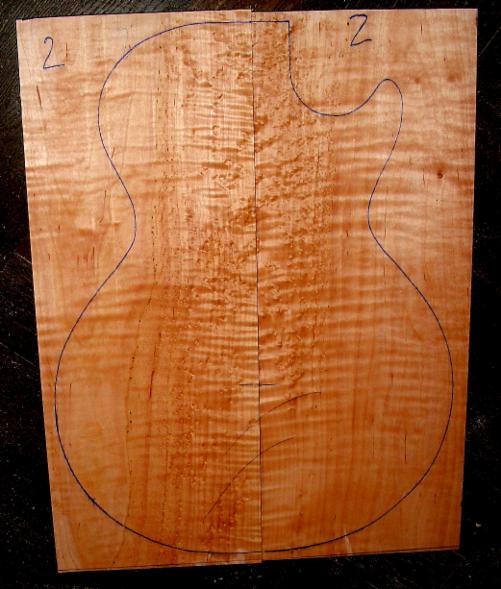
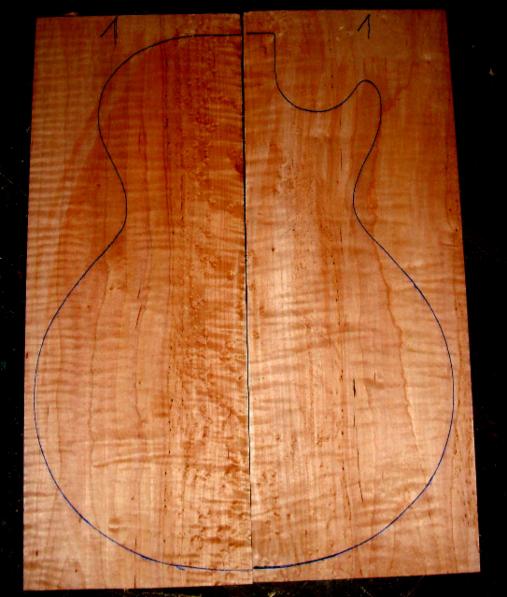
Just 2 eye-candies from our current stock of Hard Maple tops for Les Pauls, unique pieces from the same board: tops are flamed AND have bird eyes figure (never seen elsewhere myself).
Info on US Maples ("Eastern vs. Western maple")
There is some confusion reg. the various maples and especially reg. what was used on vintage Les Pauls - the following words are intended for helping to clear up some things (if necessary).
There is Big Leaf (Western) Maple which occurs out west Oregon, Washington and Western Canada. It is a lot softer and more affordable and a lot of manufacturers use it because of this.
Then there is Silver Maple which is distributed widely in the US. It is brittle and an inferior maple wood. Not really good for instruments.
Next is Red Maple most commonly called Soft Maple up North however it is actually very hard. Especially if it is from cold northern climates where it has a chance to grow slowly. They make some syrup out of it but it does not have the same sugar content in the sap as Eastern Hard Maple.
Now we come to Hard Maple which is typically a more northern species, also being called "Sugar Maple". In Europe a lot of times they use the term Hard Rock Maple. That term is not used in the US, it´s wood is harder and more dense than Red Maple. The reason they call these Eastern Maple is because they are found East of the Mississippi River. The best Hard Maple is found in Michigan because of it's cold climate and it is a major tree found in that state but only the Northern part of the state. This is the main tree for maple syrup as well as flooring and other uses. Birdseye Maple only occurs in Hard Maple and it is a freak of nature, usually in cold climates and rocky soil where the tree is distressed. It is the most expensive tree in the Western hemisphere to buy excluding BRW (for wich you need CITES documents, otherwise it is illegal). This Hard Maple is what was (mainly) used for the vintage Bursts.
Concerning figure in the wood Big Leaf Maple from the west curly is the most common in this tree.
Red Maple - curly is not as common and curly is most rare in Hard Maple. A good example: if you have 1000 Hard Maple trees you might only have 10 logs that show curly figure in Hard Maple where Red Maple you might have 50 that show figure. In the same 1000 trees you might only have one Birdseye. So what we are dealing with Curly Hard maple and Birdseye maple are the most rare and expensive. One last thing to say about these maples is that curly Card Maple and Birdseye Maple also have a tendency to have more defects than other maples. Mineral stains, worm track and heart which also make it more expensive and rare to find clean clear wood.
---
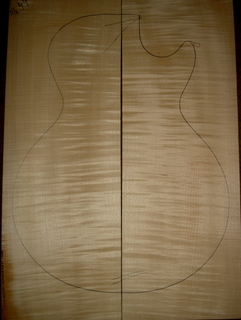
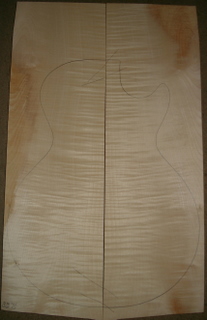
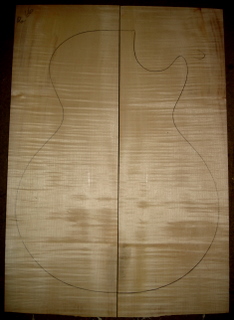
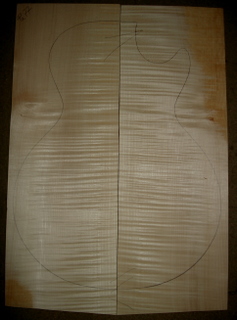
Below are some samples from high flamed European maple tops (thicknes: approx 20 mm each boockmatched half). 27 sets abailable. Click here to see deatails, more sets up soon.
-
2. Honduran mahogany bodies
We are successfully back from sourcing lightweight Honduran mahogany (swietenia macrophylla) for the body! All boards are 52 mm thick and are handselected for it´s weight and structure, of course all are flawless. This is excellent wood and FSC-certificated (Certificate #: SCS-COC-00448) ! Below are sample pics from actual stock.
Very lightweight one-piece body blanks available at 145 Euros, click here for access to the web album.
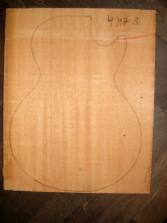
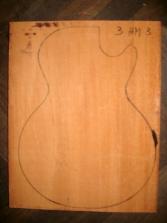
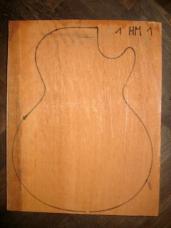
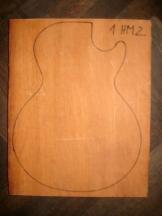
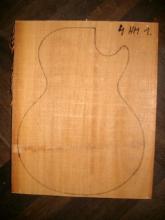
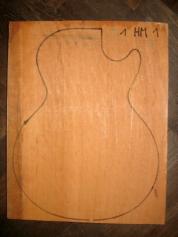
All our body blanks are excellent wood and every blank is handselected for it´s light weight.
-
3. Honduran mahogany necks
We have stocked up with excellent lightweight Honduran mahogany neck blanks for 1-piece LP necks (no ears needed).
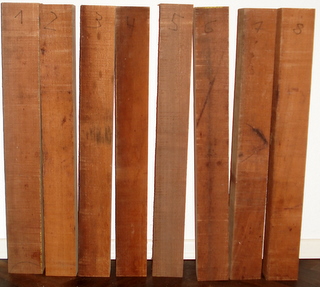
For more pics from the neck blanks above click here.
-
4. Fretboards
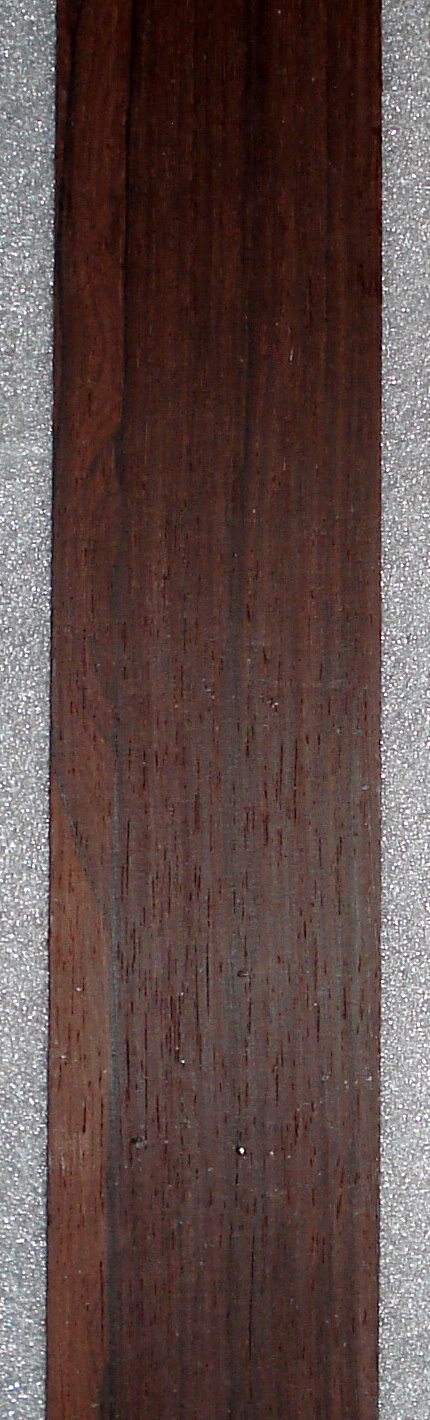
Due to CITES restrictions formerly used BRW is commercially no longer available, so Gibson changed to East Indian RW when they started to re-introduce the LP again in the 70´s (after this model was first discontinued in 1960). A more original (and more expensive than EIR) substitute for BRW is Madagascar RW, what comes in a wide range of color incl. "Rio-type".
We are lucky to have obtained a stach of Madagascar RW fingerboards that we selected for it´s BRW look that make an excellent fit for a Les Paul project. Click here or on the pic below to find more.
-
5. Holly Headplate Overlays
The vintage LPs had a headstock overlay of 0.070 inch Holly veneer, on modern LPs you will find fiber. This wood is quite rare to get and we are lucky to have a healthy stock of holly headstock overlays, sanded to approx. 0.080 inches (some are thicker) for final thicknessing in your workshop.
Below you can see samples from our stock (oversized, see headstock shape drawn onto with a pencil):
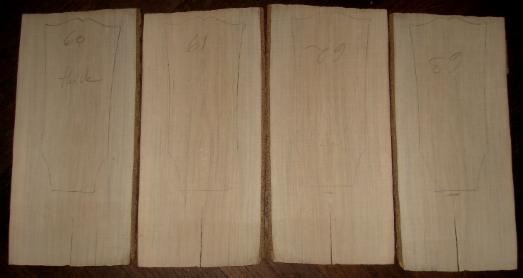
The holly headstock overlays are 19 Euro/each
5. Misc.
1. The original vintage Les Paul nuts were made of 6/6 nylon, available on request
2. The original vintage Les Paul fretboard inlays ("crown inlays") were made of
celluloid acetat (aka "Peraloid") and were NOT made of real pearl. We were lucky
enough to locate (just) one large sheet of this stuff and will soon offer CNC´d
inlay sets made from Pearloid according the vintage specifications. For more
see below.
3. Gibson did use (hot) hide glue for glueing the fretboard to the neck and later this
(both) to the body on vintage Les Paul. Furthermore they used Phenol-
Formaldehy glue/radio glue for all other gluing operations except for the frets) and
fish glue for installing the frets (advantage: you can use fish glue at
room temperature without heating and it is easy to un-glue
the frets with heat, use i. e. a soldering iron).
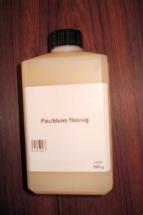
We have excellent German made fish glue in stock. If you need just the quantity
for 2 guitars just say so and we will fill up a bit for you for 3 Euro flat.
---
B: PAF´s
Handwound PAF PickUps from Tyler Henderson
Tyler (Ex-Lindy Fralin) makes outstanding handwired boutique PickUps in Germany, so it was easy for us to decide for one of his high-end PAFs - find a better one! Still an insiders´ tip, what will change soon as we think.
Below is the zebra version (not visible on the pics). These boutique pick ups are handwound for us by Tyler Henderson to average 50's specs (8.1 K neck, 9.2 K bridge) with deep bass, open and airy midrange, and silky highs.
42 AWG plain enamel wire, an AlNiCo V magnet, nickel silver covers, and 4 conductor hookup wire for phase reverse and coil tapping is used.
From us for 185 Euro/set (zebra or cream) - ask for other handwound pick ups (Strat, Tele, bass) from Tyler, esp. if you have a custom request.
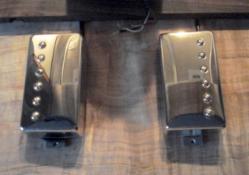
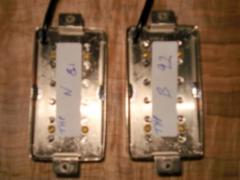
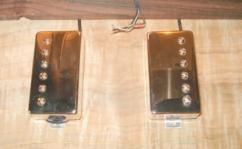 Bad pics from outstanding boutique PUs!
--------------
C: Hardware
You can find here more exclusive hardware like: pick ups, lightweight aluminium tailpieces, rare tune-o-matic bridge with brass saddles like the original "ABR-1" bridge Gibson used as well as modern alternates of stoptails and bridges from GOTOH, tuners and many more.
1. Tune-o-Matic bridge "ABR-1"
Gibson used from the beginning of the famous LP Standard (1954) a so called tune-o-matic bridge (and aluminium stoptail pieces, see below). These bridges you can find on vintage LP´s and were mouted directly into the wood (with no threads). The ABR-1 was made from nickel with brass saddles (most replicas you find these days have not brass saddles and are just look-alikes - here you get the real stuff).
We have located replicas of these with wire in Japan, incl. brass saddles (covered with nickel or natural brass uncovered). The bridges have a retaining wire to prevent the intonation screws from droping off. Available in gold (top), chrome (middle) or nickel (bottom). M4, more infos and specs you can find here.
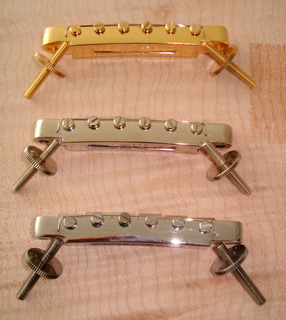
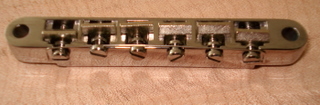
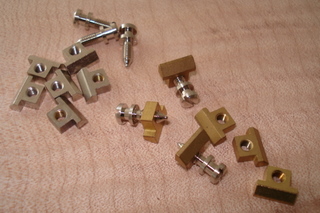
Replacement BRASS saddles (plain brass or nickel covered) you can find below or here.
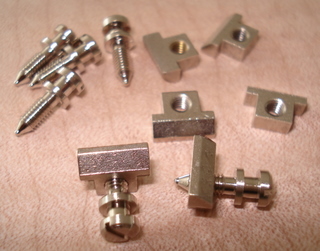 top: nickel covered brass
2. misc.
Bell "hat" knobs:
originally the knobs were more on the gold side, but some turned to more amber over the years ... we have both colors for your vintage project:
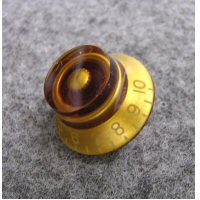 top: gold, bottom: amber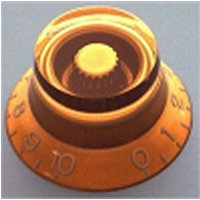
-
... and here (below) you can see vintage knobs on a real ´59 LP:
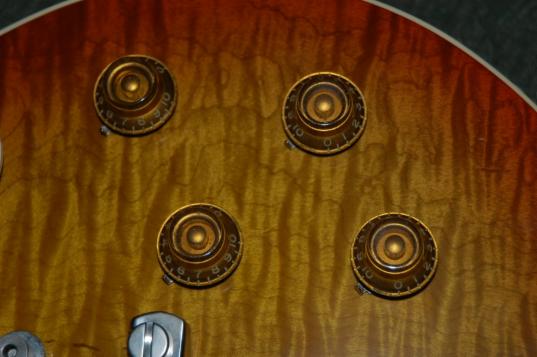
Another vintage LP:
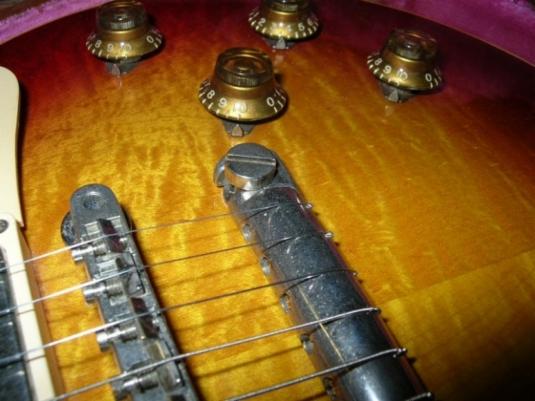
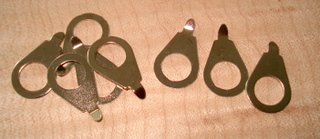
Pointer washer:
nickel, install onto the pot shaft; what more can you say about a washer ... ? Available with sharp or roundd pointer (pic = rounded pointer).
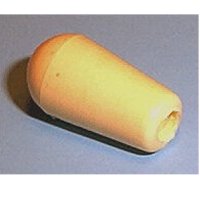
Toggel-switch tip:
Available in "vintage cream" (shown below) and in regular cream or in amber.
Toggel-switch cover and jack plate cover:
-
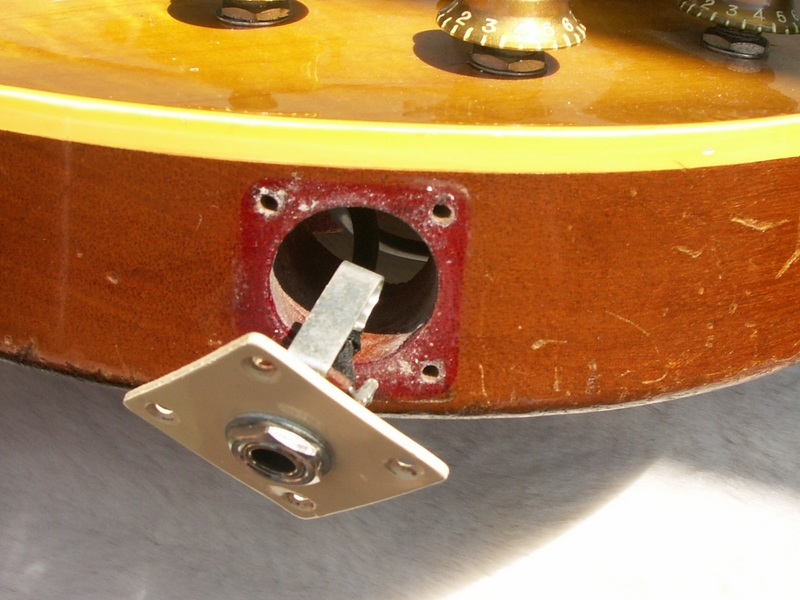
and here´s a pick from a real ´59 Les Paul with removed jack plate (note the little fading of the stain under the plate: this part was not exposed to UV and is still darker than the rest; jackplate is too thick for a vintage correct one, seems this was replaced since 1959):
3. Pots and Caps
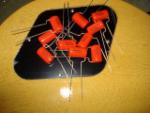
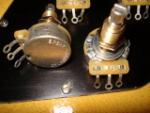
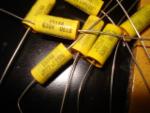
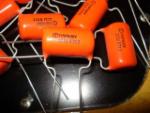
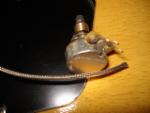
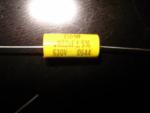
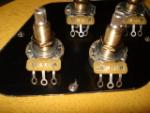
CTS long shaft audio taper pots, caps from Sprague (Orange Drop), Mallory and more like below you can find here.
--------
D: Pearloid
We were lucky enough to obtain a large sheet of real and rare Pearloid (2 mm thick), the material and color is like the vintage stuff we are all after.
This is for making crown inlays (or pickguards). Soon we will offer CNC´d pearloid crown inlays according vintage specifications.
Price will be around 75 Euro/set. If you want to get on the list with no obligations just mail.
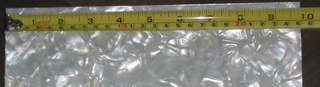
Large sheets (A2) with large pattern for spotting a wilder early 50´s or a later 50´s plain look. Each sheet is good for 10+ inlay sets! Click on the pic or here to get access to the web album with more pics (full size).
.
E: Nylon 6/6 for original nuts
The vintage Les Paul did not have a bone nut but one made of nylon 6/6. There has been some (wrong) information that the original nuts were nylon 4/6 - what is a close cousing to nylon 6/6 - but this turned out to be wrong. At NAMM 2009 Gibson informed a member of the Les Oaul Forum (www.mylespaul.com) that they got an original vintage nut analyzed and the result was that the material was nylon 6/6 (if interested in the forum post click here).
We found the same material Gibson used.
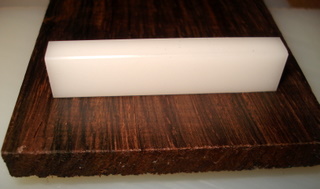
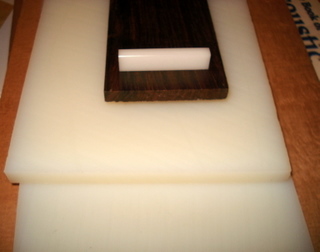
sold individually, 20 Euro/nut blank
-
F: lightweight Aluminium Tailpiece
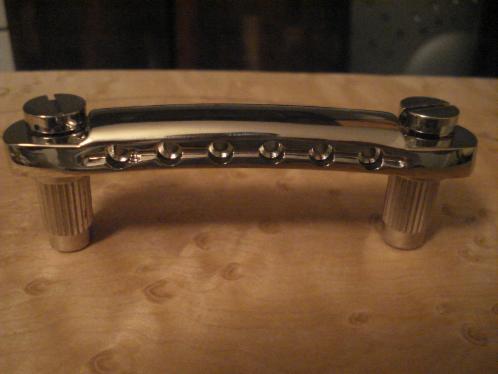
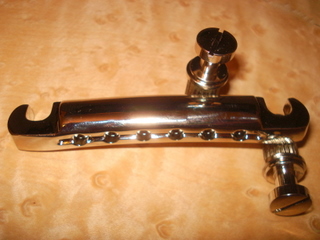
The vintage LP´s were equipped with an lightweight Alu tailpiece that weights less than 1/3rd of the regular cast ones you find everywhere. We found this so called "featherweight tailpiece", weighting just 29 grams (1 oz.), comes with studs and bushings. Go vintage correct, pics belwow:
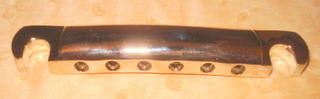
Below: back of Alu tailpiece
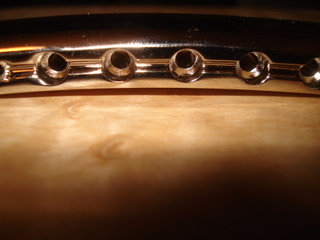
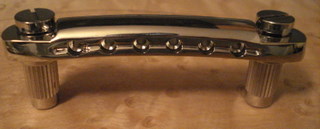
featherweight Alu tailpiece weights just 29 grams (1 oz.):
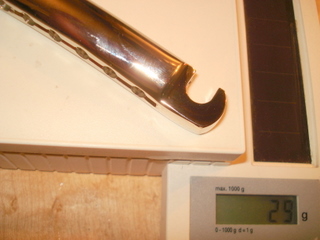
Available in nikel, chrome, black and gold. 29 Euro/set as pictured.
---------
More to come soon, watch out.
---------